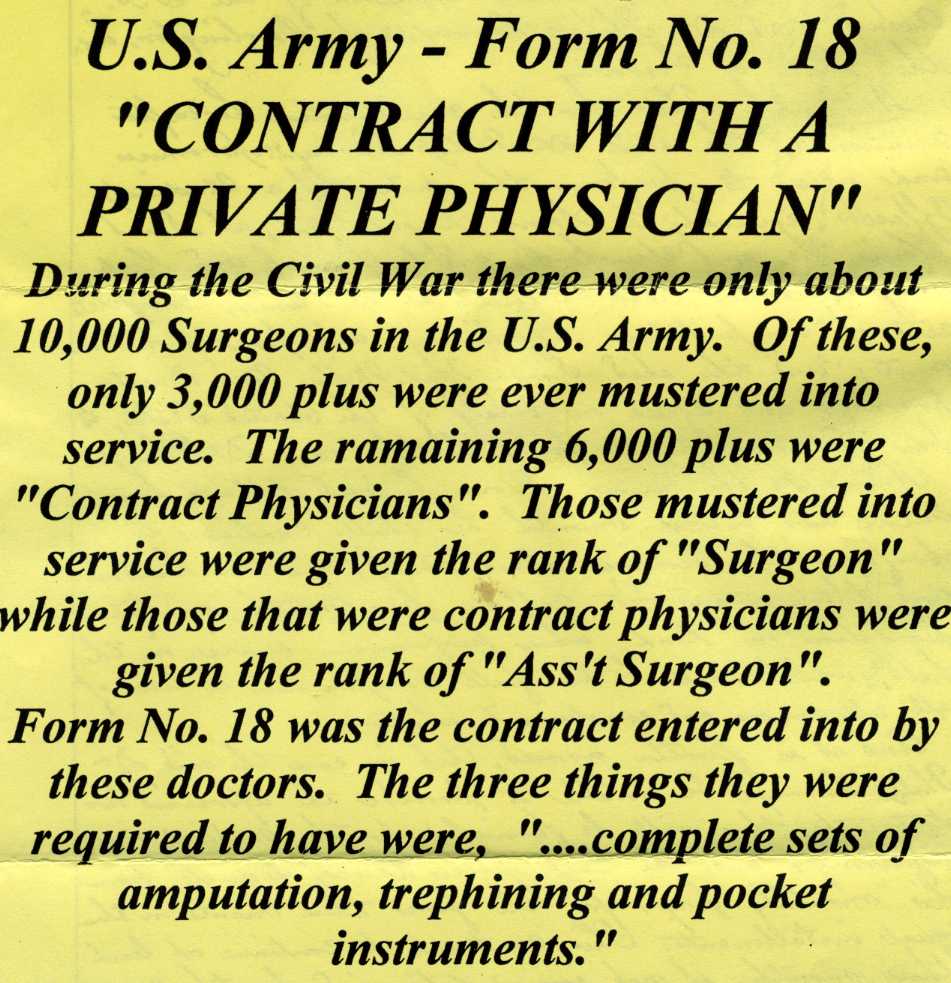
Civil War 'contract' Surgeons Hired by the U. S. ArmyU. S. Army Form No. 18
The following information regards surgical sets owned by 'contract' physicians and surgeons. The excerpts from the Medical and Surgical History of the War of Rebellion database are used to support the use of 'contract' surgeons and the existence of U. S. Army Form No. 18 which was used to pay contract physicians. The big point to consider is whether or not contract surgeons performed surgery, and if so, did they bring their own instruments as pointed out in the yellow pages. Personally I believe contract physicians were used in an auxiliary role to maintain patients and other than the first few months of they War, were not hired to perform major surgery on any patients. Surgery or amputations were mainly performed by U. S. Army certified surgeons and assistant surgeons and you may want to read the following: The Truth about Civil War Surgeons by Dr. Jay Bollet More information on Civil War Contract Surgeons The reason this information is important and needs further study is because of all the surgical sets that are floating around out there, which are claimed to have been used during the Civil War by contract surgeons. No one can prove it, but this information would certainly point toward the possibility...
A summary on the left of the facts discussed in Form 18 from the Regulations of the Medical Department of the Army. On the right, a copy of a contract signed Sept. 15, 1863, between Surgeon R. Q. Abbot and Dr. J. M. McCalla, Jr. of Washington, D.C. The last sentence in the contract states: "When instruments are furnished by the United States, the fact will be stated."
Click on images to enlarge Account of Private Physician Under ContractJohn Wheller, M.D., Pittsfield, N.H.
Payment to Dr. Wheeler: $117.50
"There was an obvious lack of
any standard of training among surgical personnel. Medical officers on both
sides of the conflict were repeatedly charged with incompetence, ignorance,
inefficiency, neglect, cruelty, carelessness and drunkenness. The reasons for
this are never more apparent than in the admission standards for the Medical
officers in the Union army. The Army Medical Board required all surgeons to
pass an oral and written test to determine their competence in the medical
sciences as well as history, geography, literature, philosophy and languages.
Many failed these examinations and at the instruction of the Secretary of War,
the requirements were significantly lowered. Thus, the number of competent
surgeons rivaled the incompetent, and those that did serve had an alarmingly
disparate base of knowledge: Army surgeons lacking in the latest knowledge of
medical theory and technology, and civilian volunteers lacking surgical
experience. Charges of needless operations performed to perfect surgical
skills, surgeons abandoning patients whose wounds proved uninteresting, and
surgeons operating while intoxicated were rampant. Equally as prevalent were
accusations of indignity and contempt in the treatment of civilian surgeons by
regular army surgeons. In response to these conditions, Surgeon General
Hammond created a “civilian-auxiliary” system in cooperation with the State’s
governors. So effective was this auxiliary that following Grant’s spring
campaign of 1864, not a single story of scandal surfaced."
Medical Reminiscences of the Civil War Remarks by John S. Billings, M.D. regarding Surgeon A. N. McLaren Read April 5, 1905
In the Fall of 1861 I went to Washington to appear before the Medical Examining Board of the Regular Army. I had graduated from a medical college after a two years' course, each year having exactly the same lectures. I had had two years' hospital experience, and I had been demonstrator of anatomy for two years, so that while I had my doubts about my passing the ordeal of the Army Medical Board, from what I had heard of its severity, still I thought that probably I should get through. I came up before the Board, and at about noon of the second day I began to feel rather comfortable and thought I was getting on very well; but by noon of the third day there was a consultation between the examiners, and they began all over again, going back to anatomy and to the beginning of things. That went on for three days more and made me very uneasy. I did not learn the explanation of this until long afterward. When it was all over Dr. McLaren, the President of the Board, said to me that he hoped I would take service at once with him - that he could not get my commission for some time, but that I could be made a contract surgeon without delay. I agreed to this, was introduced to Surgeon-General Finley, got my contract and was told that I was especially detailed to go to the Union Hotel Hospital in Georgetown, which was under the direction of Surgeon McLaren.
HEADQUARTERS OF THE ARMY, ADJUTANT GENERAL'S OFFICE, SPECIAL ORDERS, No. 323. A Board to consist of Surgeon A. N. McLAREN, U. S. A., Brigade Surgeon G. H. LYMAN, U. S. Volunteer service and Ass't Surg. M.J. ASCH, U. S. Army, is hereby instituted for the following object: To visit as many of the camps in the vicinity of Washington an they may consider necessary to obtain sufficient data to make a report to the Surgeon General on the character of the disease termed by the Medical Officers of the Brigades and Regiments "Typhoid Fever," and an far as practicable the causes of its adynamic type and whether it is to be considered an intermittent or bilious remittent fever in its inception, assuming in its course the typhoidal type or a typhoid fever primarily.
The Board will be regulated in its sessions and movements by its President so as least to interfere with the other operations of the service. The junior member will act as recorder. BY COMMAND OF MAJ. GEN'L McCLELLAN. (Signed) L. THOMAS, Adjutant General.
Documentation from the Medical and Surgical History database re:
Army Form No. 18 CORRESPONDENCE, ORDERS, REPORTS, AND RETURNS OF THE UNION AUTHORITIES FROM JANUARY 1, 1864, TO APRIL 30, 1865 EXTRACTS FROM GENERAL REGULATIONS OF THE ARMY, ARTICLE XLI.--Public property, money, accounts, and contracts.
1304. When it is necessary to employ a private physician as medical officer, the commanding officer may do it by written contract, conditioned as in Form 18 (Medical Regulations, U. S. Army), at a stated compensation, not to exceed $50 a month when the number of officers and men, with authorized servants and laundresses, is 100 or more; $40 when it is from 50 to 100; and $30 when it is under 50.
1305. But when he is required to abandon his own business, and give his whole time to the public service, the contract may be not to exceed $80 a month, and not to exceed $100, besides transportation in kind, to be furnished by the Quartermaster's Department, where he is required to accompany troops on marches or transports. But a private physician will not be employed to accompany troops on marches or transports, except by orders from the War Department, or in particular and urgent cases by the order of the officer directing the movement, when a particular statement of the circumstances which make it necessary will be appended to the contract.
1306. And when a private physician is required to furnish medicines, he will be allowed, besides the stipulated pay, from 25 to 50 per cent. on it, to be determined by the Surgeon-General.
1307. In all cases a duplicate of the contract will be transmitted forthwith by the commanding officer to the Surgeon-General, and the commanding officer for the time being will at once discontinue it, whenever the necessity for it ceases, or the Surgeon-General may so direct.
1308. The physician's account of pay due must be sent to the Surgeon-General for payment, vouched by the certificate of the commanding officer that it is correct and agreeable to contract, and that the services have been duly rendered. But when it cannot conveniently be submitted to the Surgeon-General from the frontier or the field, it may be paid on the order of the commanding officer, not to exceed the regulated amount, by a medical disbursing officer, or a quartermaster.
OFFICE
COMMISSARY-GENERAL OF PRISONERS,
Maj. W. S. PIERSON,
Yours of the 15th with Doctor Woodbridge's acceptance of the appointment of medical officer at the depot at $100 per month is just received. I send a telegram to you requesting you to employ him immediately. Make a contract with him according to Form 18, medical regulations, specifying that he is to receive the fuel and quarters of an assistant surgeon. When I return to Sandusky I will approve the contract and forward it to the Surgeon-General. If I should not return you can forward it as having been made by my order. While the men are suffering with the mumps it may be well to quarter some of them in the officers' block nearest to the gate, north side, in the inclosure. W. HOFFMAN, Lieut. Col. Eighth Infantry, Commissary. General of Prisoners EMPLOY?. 140. Employ? will be paid, at the end of each calendar month, on receipt rolls (Form 18), in duplicate, which they must sign with their own hands. One person can sign for another only by a power of attorney, a copy of which must, in each case, accompany the signature.
141. When employ? are not present at the district headquarters to sign the receipt rolls, their accounts may be made out on separate vouchers. (Form 19.) SPECIAL ORDERS No. 90.
HDQRS. DEPT. OF THE
TENNESSEE,
VIII. The commanding officer of the Sixteenth Army Corps will cause to be built on one of the islands of the Mississippi somewhere between Columbus, Ky., and Memphis, Tenn., a suitable log or frame prison for the accommodation of 1,000 prisoners. The island so occupied will be garrisoned by such a force as the corps commander may deem necessary for the safe-keeping of all prisoners intrusted to them and for holding the post. One contract physician will be habitually kept to take charge of the sick in prison and more should the number requiring medical attendance make it necessary. The expense of building such structure will be defrayed by the quartermaster's department from funds received through the provost-marshal's department. By order of Maj. Gen. U.S. Grant: JOHN A. RAWLINS,
COLUMBUS,
OHIO, August 14
W. A. HAMMOND, Surgeon. General U.S.
Army:
Allow me to draw your
attention to Camp Chase. There are now 1,600 prisoners; one regiment and
two-thirds three-months' men on guard duty. Two new regiments are nearly
filled. Orders, No. 65, has brought to camp over 3,000 sick soldiers to be
examined. The regimental surgeons are busy inspecting their own men and
taking care of them. Up till now we got along by employing a contract
surgeon and using the paroled surgeons. They are now ordered to report to
their regiments, and therefore we now need more help. A first-class man with
five good assistants ought to be appointed for this post at once. The
examination of sick soldiers being very important ought not to be intrusted
to poor hands. A first-class man cannot be procured at the usual rate. Do
give me authority to organize a staff for above camp and what compensation
will you allow? There are now more than 500 soldiers waiting examination.
Answer immediately.
GUSTAV C. E. WEBER,
Surgeon General CASE 312.--A private of Co. C, 54th
Massachusetts, a colored man, was wounded and made a prisoner in the
assault on Morris Island on July 11, 1863. A fragment of a shell from
Fort Wagner struck the upper and outer part of his right thigh, and
fractured the neck and head of the femur and the rim of the acetabulum,
and extensively lacerated the soft parts in its exit through the
posterior part of the thigh. The patient was conveyed to Charleston on
the afternoon of July 12th, and was placed in a hospital hastily
prepared for the reception of wounded colored prisoners. The contract
surgeon in charge of the hospital reports that the patient's
condition, in view of the terrible wound he had suffered, was remarkably
good, and that the symptoms of shock were unusually slight. On July
13th, the third day after the reception of the injury,
Surgeon R. A.
Kinloch, P. A. C. S., saw the case, and amputated at the hip joint
by Manec's method. The knife being entered midway between the anterior
superior spinous process of the ilium and the great trochanter, and
carried downward and inward until its point emerged just in front of the
ischium, was made to form a large antero-internal flap; the soft parts
on the outer and posterior part of the thigh were then divided by a
semicircular incision from without inward, and the head of the femur was
then disarticulated. The patient bore the operation well, but a few
hours subsequently there was extreme depression, and the case terminated
fatally on the following morning, July 14th, twenty hours after the
operation.
( Again, the point of interest for this
research is to determine if contract physicians brought their own
instruments or not. Apparently in the early months of the War,
they were encouraged to bring their own instruments, but as supplies
increased, they were not.)
|