|
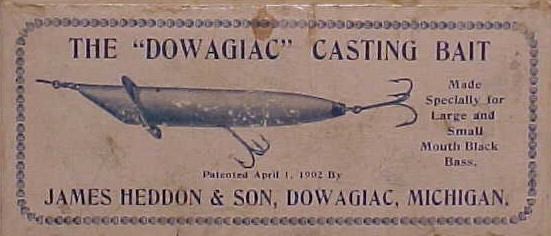
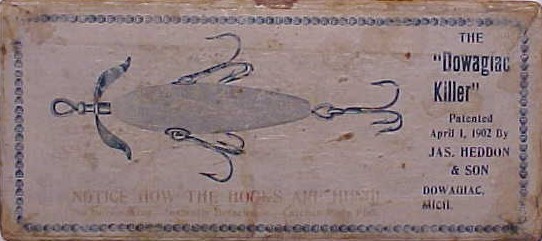
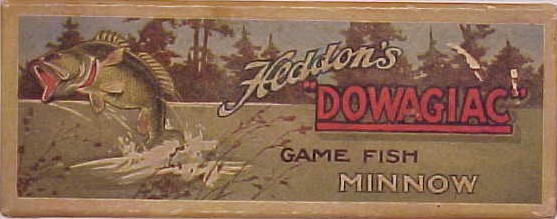
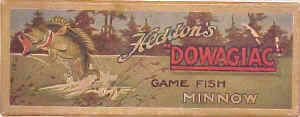
This is information I used to determine what Heddon lure should be in which Heddon box. I've found I need to coordinate hardware, lure shape, box type, and the nomenclature to match up the correct lure with the correct Heddon box. If you are in the field or at a show and need this information, it can save your butt, not to mention your wallet. Note: Some Heddon box information was drawn from discussions with various collectors, an article by Bruce Dyer, NFLCC Magazine, 1993, and Clyde Harbin's Historical Foot Prints book and Roberts and Pavey's book on Heddon. All boxes shown here were a part of this collection. Identification of early Heddon lures by hardware and prop type. Heddon Dowagiac Boxes:1906-19301902-1905: Heddon Picture boxes: the 'vine or oak leaf' type border is earlier than the double straight line design.
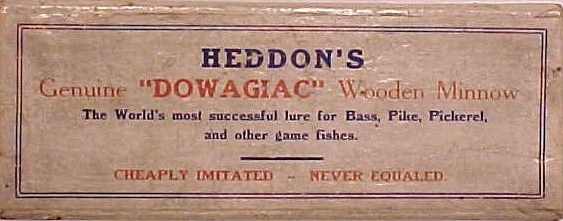
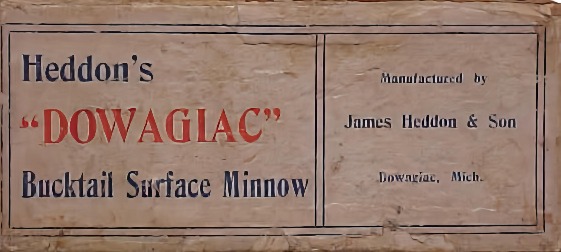
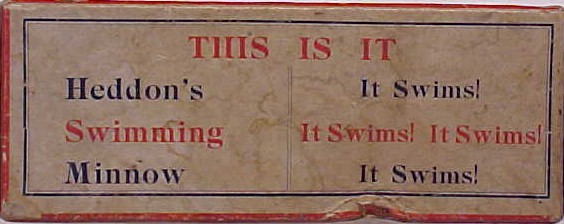
1906-1909: Heddon White cardboard and intro boxes: shows the later double straight line design.
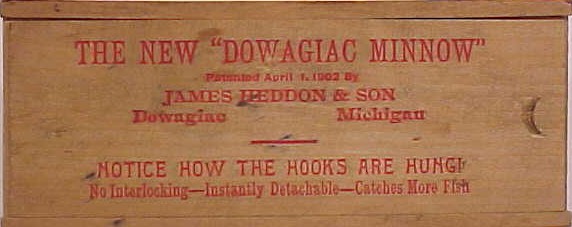
1905-1910: Heddon wood boxes (variations type 1 - 5): the more expensive line of lures were packaged in wood boxes, while the cheaper lines were sold in the white boxes/
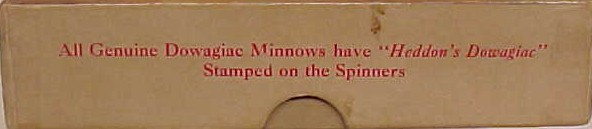
Click here for an extensive discussion of Heddon wood boxes 1912: Pinetree cardboard box: marked on side with "Stamped on Spinners" Expect fat body 100's and 150's with long gill marks, cup rig, single belly weights, Both name on the props and no name on prop as 1912 was when the name on the prop started.
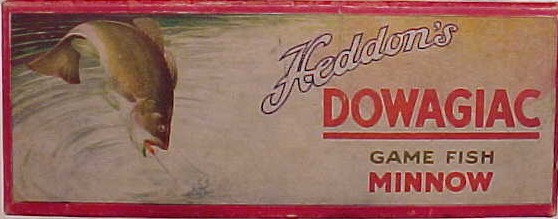
Heddon Dowagiac: Down leaping Bass boxes 1912 only: blue or white border; down leaping Bass box. Contains fat body lures with cup rig. Click here to see the correct brochure paper for this box. Note the blue border around the box on the lower left and the white border around the lower box on the right. The whole box is blue on the blue border and the whole box is white on the white border. It's just a down leaping Bass label pasted on a blue or white box whereas after this year, all the boxes are red and white.
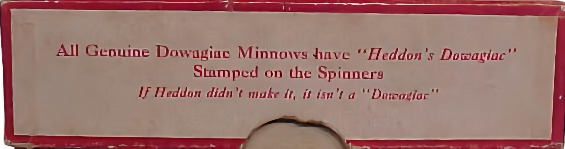
1912-@1915 "stamped on the Spinner"; down leaping Bass box
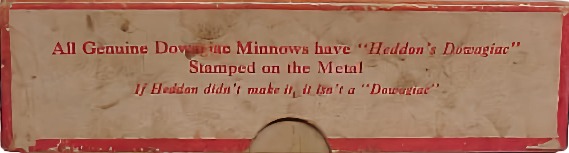
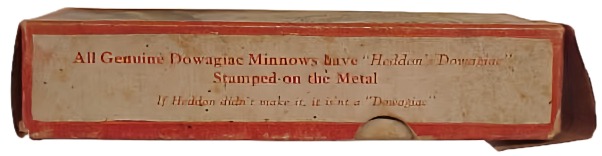
1915-@1920 "stamped on the Metal"; down leaping Bass box
1920-@1924 folded style with mis-print "is'nt"; down leaping Bass box
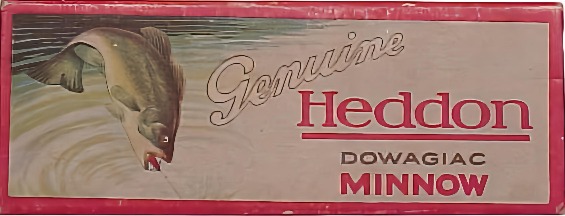
1924-@1930 Genuine on top of box; down leaping Bass box
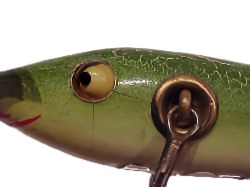
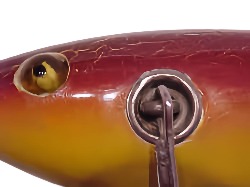
Heddon Lures: 1905 to 1909 1905 High forehead 100 with brass hardware, two belly weights, long sweeping gill marks to eyes 1906 same as above, only it has nickel hardware instead of brass 1907 first version with blunt nose, except it's a little narrower and longer 1908-9 blunt nose baits found in wood boxes Heddon 100: 1904 to 1912 Body anatomy and boxes used from 1904 to 1912 Heddon Paper Sequences of paper brochures Heddon Hardware Identifying Heddon lures can be made much easier if you know the types of hardware and the time period they were used. Cup rig: hardware typical of Heddon baits made prior to 1915-1916. The earliest cups were made of brass and the later were nickel plated. There were variations in the early years with rim anatomy and variations: detailed in the NFLCC article "Eight Years of Heddon Hardware" by Bill Sonnett. Note: there are some
later cup rigged Heddon lures which are stenciled 'Heddon' on the belly.
The body style is slim. The lure was made approximately during 1930-33.
Heddon begin putting the stencil 'Heddon' on lures approximately 1927 and
somewhere between 1930-33 they used the cup rig again for a VERY short time.
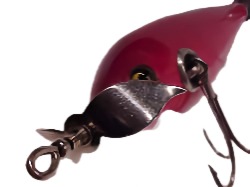
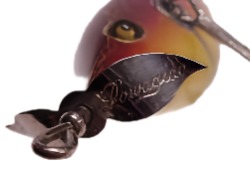
Props: Cup rig underwater minnows can have two types of props: unmarked (No Name On Prop) which dates them prior to 1915-1916; and Name On Prop, which dates them after 1911 when the name Heddon Dowagiac was stamped on the front and rear prop. Heddon made a gradual change to L-rig during the 1914-1915 time range, so it is possible to find NOP lures with cup rig . Apparently they wanted to use up the last cup rig lures and placed the new marked props on the older cup rig lures. See additional photos to identify Heddon lures by the props.
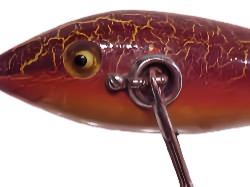
L-rig: first cataloged in 1914 on the Dummy Double. . The hook screw has an arm for an attachment screw which comes out of the cup and onto the body. Earliest L-rig is single hump, later two hump L-rig seen after 1915.
Props: Generally only Name On Prop.
Toilet seat: made in two pieces and the toilet seat shape gives it the name. This hardware was in use during 1927 to 1936. Props: Name On Prop. Two piece: known as "Flap" hardware was used starting in about 1934 and continued through the war until replaced by the current cheap looking surface type hardware in the 1948/49 range. Props: Name On Prop |